
.svg)

Display advertising claimed roughly 30% of U.S. digital ad spend in 2025, yet many marketers still question its strategic value. This guide clarifies how display ads amplify brand awareness, deliver measurable ROI through programmatic buying and retargeting, and complement search and social campaigns to optimize your entire digital marketing budget.
Table of Contents
- Introduction To Display Ads And Market Relevance
- How Display Ads Support Brand Awareness
- Performance Mechanisms And Audience Targeting
- Debunking Common Misconceptions About Display Ads
- Cost Efficiency And Budget Considerations
- Frameworks To Measure And Optimize Display Ad Roi
- Case Studies Demonstrating Display Ads’ Impact
- Discover How AdVenture PPC Can Amplify Your Display Ad Strategy
Key takeaways
| Point | Details |
|---|---|
| Brand awareness impact | Display ads increase brand awareness by 80% on average in targeted segments. |
| Cost efficiency | Display CPM runs 50 to 70% lower than social media ads, enabling broader reach. |
| Programmatic advantage | Programmatic buying boosts ROI by 35% compared to traditional display methods. |
| Retargeting power | Retargeting display ads can lift click through rates by up to 400%. |
| Measurement approach | Combine brand lift surveys, engagement metrics, and multi touch attribution for full ROI visibility. |
Introduction to display ads and market relevance
Display ads encompass banner ads, rich media, video placements, and programmatic inventory across websites and apps. They serve as visual touchpoints that introduce brands, reinforce messages, and guide prospects through multi stage customer journeys. Display ads constitute approximately 30% of U.S. digital ad spend in 2025, underscoring their continued strategic importance despite the rise of search and social platforms.
Unlike paid search, which captures bottom funnel intent, display ads excel at upper and mid funnel activities. They build awareness among audiences who may not yet recognize their need for your product. Social media ads offer similar reach, but display’s programmatic capabilities provide granular targeting across the open web, extending beyond walled gardens.
Key components of modern display advertising include:
- Programmatic buying that automates ad placements using real time bidding and audience data.
- Dynamic creative optimization that personalizes ad content based on user behavior and demographics.
- Retargeting campaigns that re engage users who previously visited your site or engaged with your brand.
- Native ad formats that blend seamlessly into publisher content for higher engagement.
- Cross device tracking that follows users from desktop to mobile for consistent messaging.
Marketing professionals allocate display budgets to complement direct response channels. Display ads generate brand equity that indirectly lifts conversion rates on search and social campaigns. They fill awareness gaps and nurture prospects who enter the funnel through organic or referral traffic. Understanding this ecosystem role helps justify display investments within integrated marketing strategies.
How display ads support brand awareness
Display ads increase brand awareness by an average of 80% within targeted audience segments, according to Nielsen brand lift studies. This measurable impact positions display advertising as a critical tool for building market presence and supporting long term revenue growth. Brand awareness serves as a leading indicator, creating mental availability that converts into sales when purchase intent emerges.
Personalization amplifies these gains. Campaigns using dynamic creatives that adapt messaging to individual user profiles see brand recall improvements of around 60%. Segmentation based on behavioral data, demographics, and purchase history ensures ads reach audiences most likely to remember and engage with your brand.
Display ads create visual anchors that persist in consumer memory far longer than text based search ads, building brand equity that compounds over time.
Effective brand awareness campaigns through display ads incorporate several strategic elements:
- Consistent visual identity across all placements to reinforce brand recognition and recall.
- Frequency capping that balances exposure with avoiding ad fatigue and negative sentiment.
- Contextual targeting that places ads on sites and content aligned with brand values and audience interests.
- Sequential messaging that tells a brand story across multiple touchpoints rather than repeating identical creative.
- Cross channel coordination that synchronizes display campaigns with social, video, and offline brand initiatives.
The awareness gains from display ads indirectly support conversion optimization. Prospects who recognize your brand from display exposure convert at higher rates when they later encounter your search ads or visit your site directly. This halo effect justifies display investments even when last click attribution undervalues their contribution. Smart marketers measure brand lift alongside direct response metrics to capture display ads’ full impact on business outcomes.
Performance mechanisms and audience targeting
Retargeting display ads increase click through rates by up to 400% compared to prospecting campaigns, transforming abandoned site visits into conversions. This dramatic performance lift stems from targeting users who already demonstrated interest, making retargeting one of display advertising’s highest ROI tactics. Behavioral data powers these results, enabling ads that reflect specific products viewed or actions taken.
Programmatic buying platforms integrate first party data from your CRM and website with third party audience segments to create precise targeting profiles. Real time bidding algorithms optimize bids based on predicted conversion probability, ensuring budget concentrates on high value impressions. This data driven approach delivers efficiency gains impossible with traditional media buying.
Audience targeting strategies that maximize display ad performance include:
- Lookalike modeling that identifies prospects sharing characteristics with your best customers.
- Intent based targeting that reaches users actively researching products or services in your category.
- Geographic and demographic filters that align campaigns with your ideal customer profile.
- Device and browser targeting that optimizes creative and landing pages for specific user contexts.
- Time of day and day of week scheduling that concentrates spend during high conversion windows.
Pro Tip: Layer multiple targeting criteria to create highly specific audience segments, then test different creative and offers against each segment to identify winning combinations that scale.
Integrating customer data platforms with programmatic buying tools enables continuous learning and optimization. Each impression generates data that refines targeting models, improving campaign performance over time. This feedback loop transforms display advertising from a static awareness play into a dynamic, data driven ad strategy that adapts to market conditions and audience behavior.
The most sophisticated display campaigns use predictive analytics to identify users entering the market for your products. By targeting prospects before they begin active search behavior, you capture attention early in the decision process and influence consideration set formation. This preemptive approach positions your brand as the category leader rather than just another option.
Debunking common misconceptions about display ads
Many marketing professionals dismiss display ads as purely upper funnel branding tools with limited conversion impact. Evidence contradicts this myth. Research shows 45% of marketers find display ads effective for lead generation, especially when combining programmatic targeting with retargeting strategies. Display ads contribute across the entire funnel when implemented with proper audience segmentation and measurement.
Programmatic display buying increases ROI by 35% compared to traditional direct buys through publishers. Automated optimization, granular targeting, and real time bidding eliminate the inefficiencies of manual insertion orders. Yet skepticism persists, often rooted in outdated experiences with poorly targeted banner ads from the early 2000s.
Common misconceptions that undermine display ad investments include:
- Belief that banner blindness renders all display ads ineffective, ignoring creative quality and targeting precision differences.
- Assumption that low click through rates equal poor performance, missing view through conversions and brand lift impacts.
- Perception that display ads only work for large consumer brands, not B2B or niche markets with smaller audiences.
- Concern that ad fraud and viewability issues waste budgets, despite major improvements in verification technology.
- Notion that display ads cannot drive immediate conversions, contradicting retargeting campaign results.
Modern display advertising bears little resemblance to the static banner ads of the past, yet legacy perceptions continue to shape budget allocation decisions.
Accurate measurement reveals display ads’ multi faceted ROI contributions. Multi touch attribution models credit display impressions that assist conversions, even when users ultimately click a search ad or visit directly. Display advertising ROI explained through proper attribution shows these campaigns often generate positive returns that last click models completely miss.
Marketing professionals who understand display advertising’s evolved capabilities make better budget decisions. They allocate sufficient resources to awareness and consideration activities, recognizing that conversion optimization requires a full funnel approach. Dismissing display ads based on outdated assumptions leaves money on the table and cedes market share to competitors who leverage the channel effectively.
Cost efficiency and budget considerations
Display ad CPM is typically 50 to 70% lower than social media CPM, offering substantial cost efficiency for campaigns requiring broad reach. This pricing advantage enables marketing teams to generate significantly more impressions within fixed budgets, extending brand exposure and retargeting pool size. For awareness campaigns targeting large audiences, display’s cost structure delivers unmatched efficiency.

The CPM differential stems from supply and demand dynamics. Display inventory across the open web vastly exceeds supply on social platforms, creating competitive pricing for advertisers. Programmatic buying amplifies this advantage by accessing remnant inventory at discounted rates while maintaining quality through publisher whitelists and contextual targeting.
| Channel | Average CPM | Reach Efficiency | Best Use Case |
|---|---|---|---|
| Display Ads | $2 to $10 | High volume, broad targeting | Awareness, retargeting, brand building |
| Social Media | $5 to $20 | Precise demographic targeting | Engagement, community building |
| Video Ads | $10 to $30 | High engagement, storytelling | Product demos, emotional connection |
| Paid Search | CPC model | High intent capture | Direct response, conversions |
Budget allocation should reflect display ads’ distinct funnel role. Awareness and consideration campaigns naturally show lower immediate conversion rates than bottom funnel search campaigns. Smart marketers evaluate display performance against appropriate benchmarks like brand lift, engagement rate, and assisted conversions rather than expecting direct response metrics.
Balancing spend across search, social, and display maximizes overall ROI by addressing all funnel stages. Underfunding display ads creates awareness gaps that limit the prospect pool for conversion focused channels. Overfunding display at the expense of search leaves money on the table by missing high intent traffic.
Pro Tip: Allocate 20 to 30% of your digital budget to display advertising for upper and mid funnel activities, adjusting based on your sales cycle length and brand awareness needs.
Cost efficiency makes display ads ideal for campaigns with broad awareness goals, large retargeting audiences, or geographic expansion initiatives. The low CPM enables testing new markets and audience segments without substantial risk. As you identify high performing segments through display campaigns, you can reallocate budget to more expensive channels for final conversion pushes.
Frameworks to measure and optimize display ad ROI
Measuring display ad ROI requires combining brand lift surveys, engagement metrics, and multi touch attribution to capture both direct and indirect value. Single metric approaches like last click attribution systematically undervalue display’s contribution, leading to suboptimal budget decisions. Comprehensive measurement frameworks reveal the full picture of how display advertising drives business outcomes.
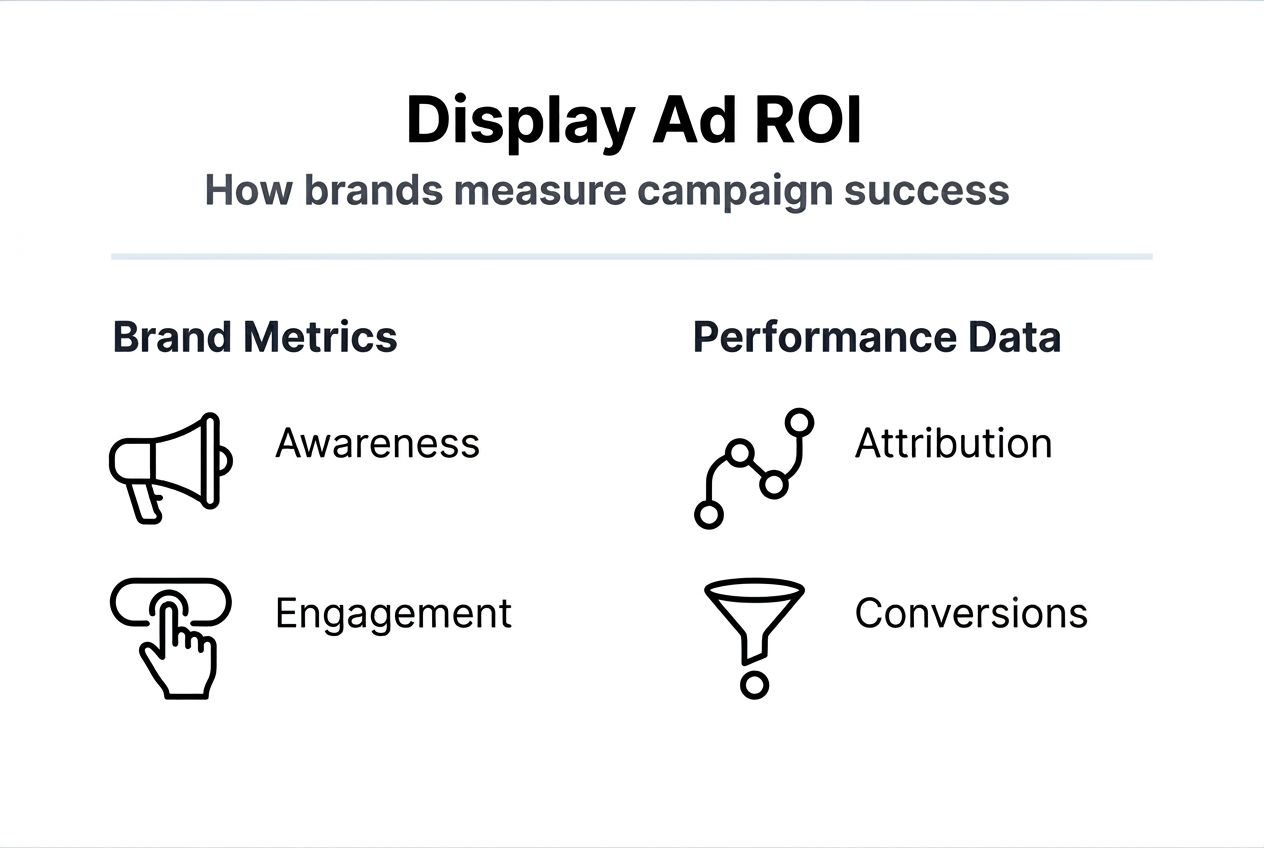
Multi touch attribution models credit display impressions that occur anywhere in the customer journey, not just the final click. Position based, time decay, and data driven models distribute conversion credit across touchpoints, providing accurate ROI calculations. This approach shows display ads’ role in initiating consideration and nurturing prospects toward conversion.
Follow these steps to implement effective display ad measurement and optimization:
- Establish baseline brand awareness and consideration metrics through surveys before launching display campaigns.
- Set clear KPIs aligned with campaign goals, distinguishing between awareness metrics like reach and engagement versus conversion metrics.
- Implement view through conversion tracking to capture users who convert after seeing but not clicking display ads.
- Deploy multi touch attribution modeling to credit display impressions that assist conversions across the customer journey.
- Conduct regular brand lift studies to measure changes in awareness, recall, and purchase intent among exposed audiences.
- Analyze engagement metrics like time on site and pages per session for display driven traffic compared to other sources.
- Optimize campaigns continuously based on data insights, reallocating budget toward high performing placements, creatives, and audiences.
Integrated analytics platforms connect display campaign data with website behavior, CRM records, and sales outcomes. This unified view enables sophisticated analysis like cohort comparisons between users exposed to display ads versus control groups. The incremental lift calculation isolates display’s causal impact on conversions and revenue.
Regular optimization cycles improve campaign efficiency over time. Test different audience segments, creative variations, and bidding strategies while measuring impact on your defined KPIs. Measure ad performance for higher ROI by establishing feedback loops that turn data into actionable insights.
Sophisticated marketers use incrementality testing to validate display ad effectiveness. By randomly withholding display ads from a control group, you can measure the true causal impact on conversions and revenue rather than relying on correlational attribution models. This approach provides the most rigorous ROI proof for display investments.
Case studies demonstrating display ads’ impact
Real world results validate display advertising’s strategic value across diverse business models. AdVenture PPC client Grown Brilliance, a lab grown diamond retailer, increased conversions by 25% through integrated display and search campaigns. The display component built brand awareness and captured prospects early in the luxury purchase consideration process, while search ads converted high intent traffic.
Integrated campaigns combining display with other channels consistently outperform siloed efforts. Display ads expand the prospect pool and warm audiences for more expensive conversion focused channels. Case studies across industries show this synergistic effect, with total ROI exceeding the sum of individual channel returns.
Key success factors from display advertising case studies include:
- Programmatic buying that continuously optimizes toward conversion probability and customer lifetime value.
- Dynamic creative optimization that personalizes messaging based on user behavior and demographics.
- Strategic retargeting that re engages site visitors with tailored offers reflecting their browsing history.
- Cross channel measurement that captures display ads’ role in multi touch customer journeys.
- Continuous testing and learning that refines targeting, creative, and bidding strategies over time.
High growth brands leverage display advertising ROI explained through proper attribution to justify expanding investments. They recognize display ads as lead generation tools rather than just awareness vehicles. Sophisticated targeting and retargeting transform display from a branding expense into a performance channel with measurable revenue impact.
B2B companies demonstrate similar success using display ads for account based marketing. Targeting specific companies and job titles with personalized creative generates qualified leads and accelerates sales cycles. Combined with robust digital marketing ROI measurement frameworks, these campaigns prove their value through pipeline contribution and closed deals.
The most effective display campaigns apply data driven optimization principles continuously. Regular analysis identifies winning audience segments, high performing creative elements, and optimal bidding strategies. This iterative approach, detailed in guides on how to optimize ad campaigns for ROI, transforms initial tests into scalable profit centers.
Discover how AdVenture PPC can amplify your display ad strategy
AdVenture PPC delivers data driven display advertising solutions that boost brand visibility and ROI for marketing teams at growing enterprises. Our programmatic and retargeting campaigns achieve measurable results through strategic audience targeting, creative optimization, and continuous performance improvement. Explore success stories like our performance creative case study for luxury brands and conversion rate growth case study for high volume lead generation clients. Our team implements the measurement and optimization frameworks detailed in this guide, connecting display investments to tangible business outcomes. Contact AdVenture PPC to discover how professional display advertising management can elevate your marketing strategy and maximize ROI across all channels.
FAQ
What makes display ads different from other digital ads?
Display ads focus on visual brand exposure across websites and apps through banner, rich media, and video formats, complementing search ads’ intent driven approach. They enable upper funnel targeting based on demographics and behavior rather than keywords, plus retargeting capabilities that re engage previous site visitors. Display ads build awareness and consideration, while search captures existing demand.
How can I measure the ROI of display advertising effectively?
Combine brand lift surveys that measure awareness changes, engagement metrics like time on site and pages viewed, and multi touch attribution that credits display impressions assisting conversions. View through conversion tracking captures users who convert after seeing but not clicking your ads. Regular optimization based on these integrated metrics improves efficiency and ROI over time.
Are display ads still effective for lead generation?
Yes, 45% of marketers report display ads as effective for lead generation when using programmatic targeting and retargeting strategies. Display ads work across multiple funnel stages, warming prospects for conversion and directly generating leads through compelling offers. Retargeting campaigns perform especially well, achieving click through rates up to 400% higher than prospecting efforts.
What is the role of programmatic buying in display advertising?
Programmatic buying automates ad purchases using real time bidding and data driven targeting algorithms, eliminating manual insertion orders with publishers. This approach increases ROI by 35% compared to traditional display buying through continuous optimization toward conversion goals. Programmatic platforms integrate audience data for precise targeting and dynamic creative personalization that improves campaign performance.
Recommended


.png)
Campaign Consolidation and Smart Bidding Helps Local Business Expand Into New Territories


Slinger Bag becomes #1 tennis launcher in the US, with 12.6X Facebook ROAS

.svg.png)
Budget Optimization Leads to eCommerce Growth For Sennheiser
Request A Marketing Proposal
We'll get back to you within a day to schedule a quick strategy call. We can also communicate over email if that's easier for you.
Visit Us
New York
1074 Broadway
Woodmere, NY
Philadelphia
1429 Walnut Street
Philadelphia, PA
Florida
433 Plaza Real
Boca Raton, FL
General Inquiries
info@adventureppc.com
(516) 218-3722
AdVenture Education
Over 300,000 marketers from around the world have leveled up their skillset with AdVenture premium and free resources. Whether you're a CMO or a new student of digital marketing, there's something here for you.
OUR BOOK
We wrote the #1 bestselling book on performance advertising
Named one of the most important advertising books of all time.
buy on amazon
OUR EVENT
DOLAH '24.
Stream Now.
Over ten hours of lectures and workshops from our DOLAH Conference, themed: "Marketing Solutions for the AI Revolution"
check out dolah
The AdVenture Academy
Resources, guides, and courses for digital marketers, CMOs, and students. Brought to you by the agency chosen by Google to train Google's top Premier Partner Agencies.
Bundles & All Access Pass
Over 100 hours of video training and 60+ downloadable resources
 view bundles →
.png)


