
.svg)

Over 80 percent of American businesses now rely on online advertising to reach new customers. With digital competition at an all-time high, understanding how to get your brand noticed has never been more important. Google Ads stands out as a leading solution, promising precise targeting and measurable results for companies of every size.
Table of Contents
- What Google Ads Is and How It Works
- Key Campaign Types and Their Advantages
- Advanced Targeting and Measurement Capabilities
- Costs, Risks, and Maximizing ROI
- Comparing Google Ads to Social Platforms
Key Takeaways
| Point | Details |
|---|---|
| Google Ads Utilizes PPC Model | Businesses only pay when users click on ads, making it a cost-effective strategy for reaching potential customers. |
| Diverse Campaign Types Available | Google Ads offers various campaign types, including Search, Display, Video, and Shopping, allowing for tailored marketing strategies. |
| Advanced Targeting Capabilities | Advertisers can leverage sophisticated targeting options based on demographics, keywords, and geographic location for better audience reach. |
| Flexibility in Budget Management | Companies have the freedom to set their own budgets with no minimum spending requirements, enabling effective participation regardless of size. |
What Google Ads Is and How It Works
Google Ads is a powerful digital advertising platform that helps businesses connect with potential customers across multiple online channels. Developed by Google as an online advertising service, this platform enables companies to display targeted advertisements that appear in search results, websites, mobile apps, and video platforms.
At its core, Google Ads operates on a pay-per-click (PPC) model, which means advertisers only pay when someone actually clicks on their advertisement. This approach provides businesses with a cost-effective marketing strategy that delivers measurable results. Companies can create highly specific ad campaigns targeting precise audience segments using advanced parameters like keywords, geographic location, user demographics, and browsing behaviors.
The platform offers remarkable flexibility for businesses of all sizes. Advertisers can set their own budget without minimum spending requirements and track comprehensive performance metrics. Businesses can promote their services to people actively searching for their specific offerings across multiple Google properties including Search, YouTube, and partner websites. This means you can reach potential customers precisely when they are most interested in your products or services.
Pro Tip for Successful Google Ads: Start with a modest budget and carefully track your campaign performance. Experiment with different keyword combinations and audience targeting to discover what generates the most effective results for your specific business goals.
Through strategic PPC campaign management, businesses can transform their digital advertising approach and drive meaningful growth.
Key Campaign Types and Their Advantages
Google Ads offers a diverse array of campaign types designed to help businesses reach their target audiences across multiple digital platforms. Search campaigns represent the foundation of Google’s advertising ecosystem, displaying text advertisements directly in search engine results when users look for specific keywords related to a business’s products or services.
Beyond search advertising, businesses can leverage several strategic campaign types. Display campaigns allow advertisers to place visual advertisements across Google’s extensive Display Network, reaching potential customers while they browse websites and mobile apps. Video campaigns provide opportunities to engage audiences through compelling video content on YouTube and partner platforms, while Shopping campaigns showcase product listings with detailed information to help potential buyers make informed purchasing decisions.
The platform’s flexibility enables businesses to create targeted ad formats including text, image, and video advertisements that align precisely with their marketing objectives. App campaigns offer another powerful option, helping businesses promote mobile applications across multiple channels and drive app installations by targeting users most likely to be interested in their specific offerings.

Pro Tip for Campaign Selection: Analyze your specific business goals, target audience, and available creative assets before selecting a campaign type. Different campaign types work best for different objectives, so match your strategy to the most appropriate advertising format.
Automated bidding strategies can further optimize your campaign performance, helping you maximize your advertising investment across these diverse campaign types.
Here is a summary of major Google Ads campaign types and their ideal use cases:
| Campaign Type | Best For | Ad Format Example |
|---|---|---|
| Search | Capturing high purchase intent | Text ads in search |
| Display | Brand awareness, retargeting | Image ads on websites |
| Video | Audience engagement | YouTube video ads |
| Shopping | E-commerce product promotion | Product listings |
| App | Driving app installs | Ads in apps & Play Store |
Advanced Targeting and Measurement Capabilities
Google Ads provides sophisticated targeting capabilities that enable businesses to reach their ideal customers with unprecedented precision. The platform’s advanced targeting system combines multiple signals including keywords, browsing history, demographic information, and user intent to create highly focused advertising experiences. Advertisers can now implement campaigns locally, nationally, or internationally, giving them unprecedented flexibility in reaching potential customers.
The platform’s targeting capabilities extend far beyond traditional advertising methods. Keyword targeting allows businesses to display ads when users search for specific terms related to their products or services. Demographic targeting enables advertisers to narrow their audience based on age, gender, income level, and other critical characteristics. Geographic targeting takes this a step further, allowing businesses to show ads only to users in specific locations, ensuring marketing budgets are spent efficiently.
Google Ads provides comprehensive performance tracking and reporting that helps businesses understand their advertising effectiveness. Advertisers can monitor detailed metrics including website clicks, phone calls, conversion rates, and overall campaign performance. The platform’s Topics API represents a cutting-edge approach to audience targeting, leveraging browsing history stored in web browsers to deliver more relevant advertising experiences.
Pro Tip for Targeting Success: Start with broad targeting and progressively narrow your audience based on actual campaign performance data. Continuously test and refine your targeting parameters to improve ad relevance and reduce unnecessary spending.
Marketing measurement strategies can transform how businesses approach their digital advertising investments, turning data into actionable insights.
Costs, Risks, and Maximizing ROI
Google Ads operates on a pay-per-click (PPC) pricing model that provides businesses with a flexible and controlled approach to digital advertising spending. Unlike traditional advertising channels, this model allows companies to set precise budgets and only pay when users actually interact with their advertisements. The transparent cost structure enables businesses to manage their marketing expenses with unprecedented granularity, making digital advertising accessible for organizations of all sizes.
However, the platform is not without potential risks. Click fraud represents a significant concern, where automated systems or malicious actors generate artificial clicks that drain advertising budgets without producing genuine user engagement. Sophisticated advertisers mitigate these risks by implementing robust tracking mechanisms, monitoring campaign performance closely, and utilizing Google’s built-in fraud detection technologies. Careful campaign management involves continuously analyzing metrics, adjusting targeting strategies, and refining ad creatives to ensure optimal performance.
Businesses can set budgets with remarkable flexibility, with no minimum spending requirements allowing even smaller organizations to participate effectively. Strategic budget allocation involves understanding key performance indicators like cost-per-click, conversion rates, and overall return on ad spend. Advanced advertisers often leverage performance tracking reports that provide detailed insights into website clicks, phone calls, and comprehensive campaign metrics, enabling data-driven decision-making.
Pro Tip for Budget Optimization: Start with conservative daily budgets and gradually increase spending as you validate campaign performance. Monitor your conversion rates and adjust targeting to improve cost efficiency.
Profit-based bidding strategies can transform how businesses approach their digital advertising investments, turning complex data into actionable marketing insights.
Comparing Google Ads to Social Platforms
Google Ads represents a fundamentally different advertising approach compared to social media advertising platforms, primarily distinguished by its intent-driven targeting mechanism. While social platforms rely heavily on demographic and interest-based targeting, Google Ads captures users at the precise moment they are actively searching for specific products, services, or solutions. This crucial difference means advertisers can connect with potential customers who are already demonstrating explicit purchase intent.
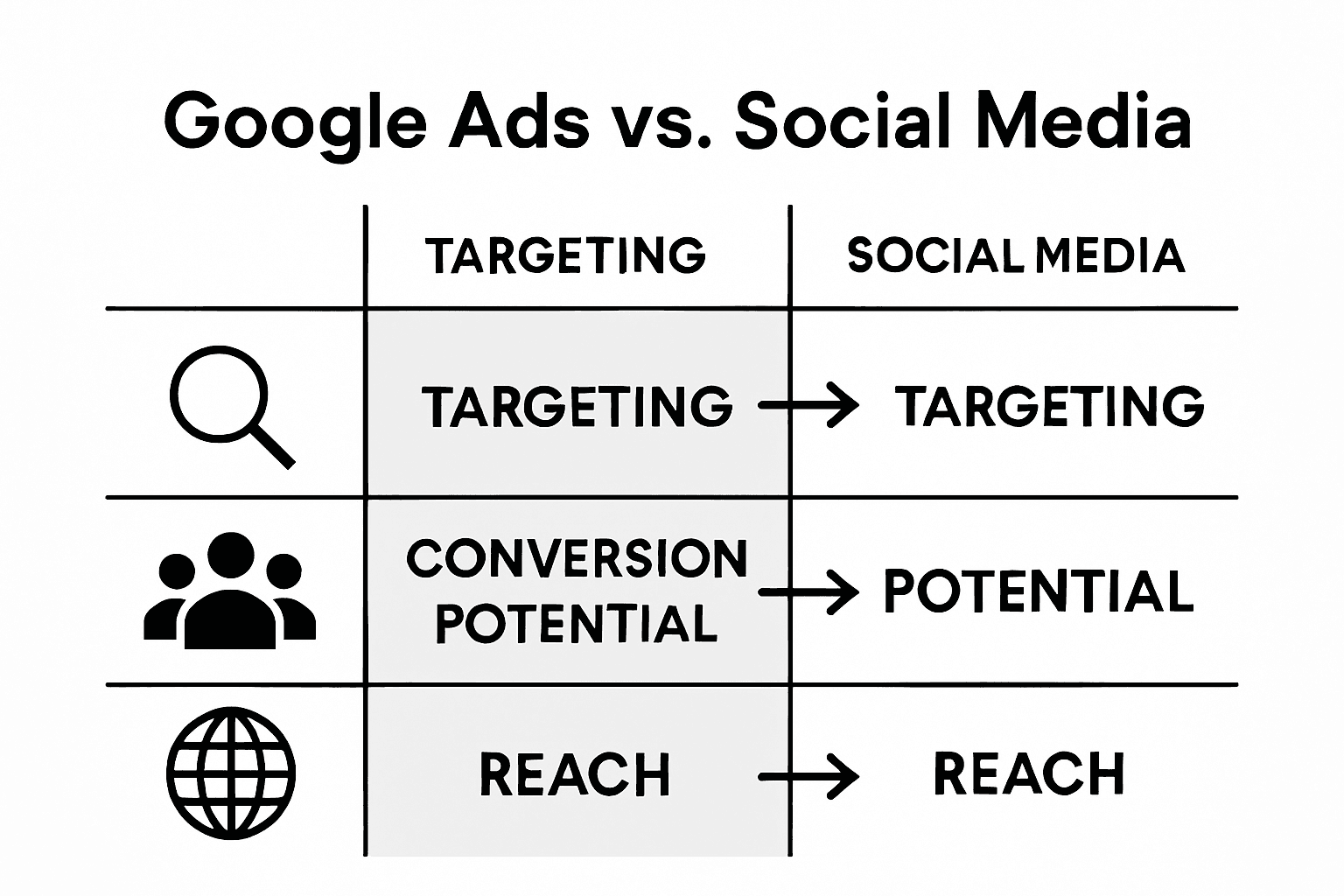
The targeting capabilities differ significantly between these platforms. Social media advertising excels at building brand awareness and leveraging detailed demographic insights, allowing precise audience segmentation based on interests, behaviors, and personal characteristics. Google Ads, conversely, focuses on keyword intent, enabling businesses to intercept users precisely when they are most likely to make a purchasing decision. Search intent targeting provides a more direct path to conversion compared to the more passive engagement typical of social media advertising.
This table compares core strengths of Google Ads and social media advertising for digital marketers:
| Platform | Targeting Focus | Conversion Potential | Reach Scope |
|---|---|---|---|
| Google Ads | Search & intent-based | High for direct response | Web, apps, YouTube |
| Social Platforms | Demographic & interest | Strong for brand awareness | Platform-bound users |
From a technical perspective, Google’s advertising ecosystem offers broader reach across multiple digital touchpoints. Google’s advertising network extends beyond search results to include websites, mobile apps, and video platforms, providing advertisers with a more comprehensive digital presence. Social platforms typically confine advertisements to their own ecosystem, whereas Google Ads can dynamically appear across an extensive network of digital properties, increasing potential customer touchpoints and brand visibility.
Pro Tip for Cross-Platform Strategy: Don’t view Google Ads and social media advertising as competing channels, but as complementary strategies that serve different marketing objectives. Use social platforms for brand awareness and Google Ads for direct response and intent-driven conversions.
Social media advertising strategies can be effectively integrated with search advertising to create a comprehensive digital marketing approach.
Unlock Profitable Growth with Expert Google Ads Management
Navigating the complexities of Google Ads can feel overwhelming, especially when managing budgets, targeting the right audience, and optimizing campaigns for maximum return on investment. This article highlights common challenges like click fraud, precise targeting, and campaign selection—all critical pain points that stand between businesses and profitable growth. At AdVenture Media, we specialize in transforming these challenges into opportunities by delivering data-driven, performance-focused Google Ads strategies that align perfectly with your business goals.
If you are ready to move beyond guesswork and unlock the full potential of search and intent-based advertising, our team provides the expert guidance and hands-on management your campaigns need. Discover how we combine advanced PPC management, conversion rate optimization, and tailored creative strategy to drive measurable results. Start your journey today by contacting us at AdVenture Media Contact to get a customized plan that puts your Google Ads investment to work smarter and more profitably.
Frequently Asked Questions
What is Google Ads and how does it work?
Google Ads is a digital advertising platform that helps businesses connect with potential customers by displaying targeted ads across search results, websites, and apps. It operates on a pay-per-click model, meaning businesses only pay when someone clicks on their ad.
What are the major types of campaigns available in Google Ads?
Google Ads offers several campaign types, including Search, Display, Video, Shopping, and App campaigns. Each type serves different marketing objectives, such as driving traffic, increasing brand awareness, or promoting products directly.
How can businesses improve their Google Ads campaign performance?
To improve campaign performance, businesses should start with a modest budget, track their performance metrics, experiment with different keywords, and refine their targeting based on actual results. Automated bidding strategies can also help maximize ROI.
What should I consider when setting a budget for Google Ads?
When setting a budget for Google Ads, consider your overall marketing objectives, cost-per-click, conversion rates, and target audience. Starting with a conservative budget and gradually increasing it as you gauge your campaign’s effectiveness can lead to better cost efficiency.
Recommended


Baketivity YoY Growth Soars after Analyzing Customer LTV's
.avif)

PictureFrames.com Sees Profitable Ecommerce Sales Growth Year Over Year
.avif)

VersaDesk Stands Up To Competition, Wins Back Bottom Funnel Traffic.
Request A Marketing Proposal
We'll get back to you within a day to schedule a quick strategy call. We can also communicate over email if that's easier for you.
Visit Us
New York
1074 Broadway
Woodmere, NY
Philadelphia
1429 Walnut Street
Philadelphia, PA
Florida
433 Plaza Real
Boca Raton, FL
General Inquiries
info@adventureppc.com
(516) 218-3722
AdVenture Education
Over 300,000 marketers from around the world have leveled up their skillset with AdVenture premium and free resources. Whether you're a CMO or a new student of digital marketing, there's something here for you.
OUR BOOK
We wrote the #1 bestselling book on performance advertising
Named one of the most important advertising books of all time.
buy on amazon
OUR EVENT
DOLAH '24.
Stream Now.
Over ten hours of lectures and workshops from our DOLAH Conference, themed: "Marketing Solutions for the AI Revolution"
check out dolah
The AdVenture Academy
Resources, guides, and courses for digital marketers, CMOs, and students. Brought to you by the agency chosen by Google to train Google's top Premier Partner Agencies.
Bundles & All Access Pass
Over 100 hours of video training and 60+ downloadable resources
 view bundles →
.png)


